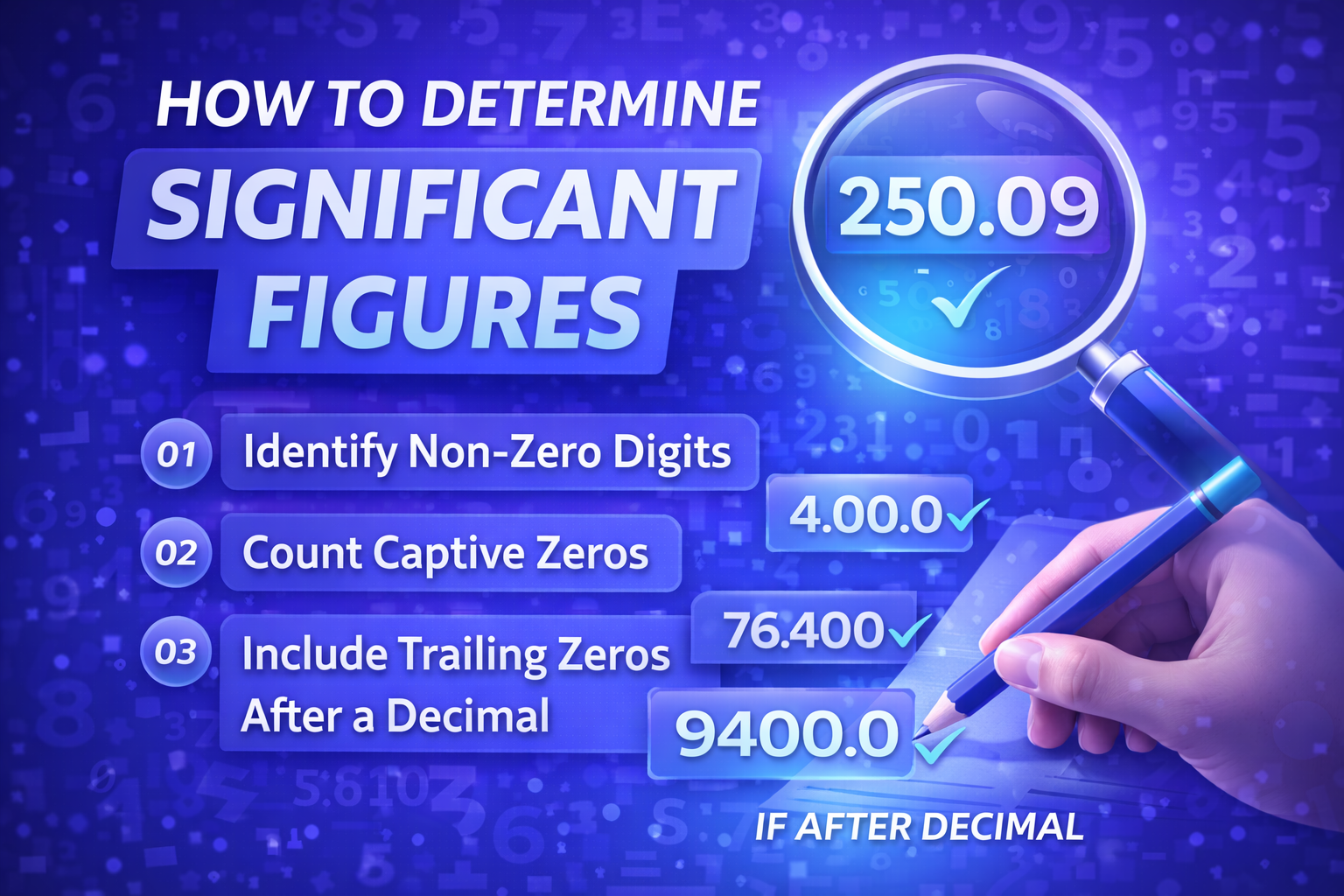
Understanding how to determine significant figures is essential when you work with measurements in science, engineering, finance, or everyday problem-solving. Significant figures communicate precision, not just numbers, and they tell you how reliable a measurement truly is.
When you master this skill, you avoid costly rounding mistakes and produce results that reflect true accuracy, so continue reading to gain complete clarity and confidence.
What Significant Figures Actually Mean
Significant figures represent the digits in a number that carry meaningful information about its precision. When you measure 12.30 inches, you are not simply stating a value, but also indicating that the measurement is precise to the hundredth place. This distinction separates scientific accuracy from guesswork and helps you communicate results correctly.
You should think of significant figures as a built-in reporting system for uncertainty. Every measurement tool, from a ruler to a digital scale, has limits, and the digits you report reflect those limits. When you understand how significant figures work, you strengthen your decision-making in lab work, academic testing, and professional calculations.
The Core Rules for Counting Significant Figures
You must first identify which digits count and which do not. These rules apply consistently across math, chemistry, physics, and engineering disciplines. Once you internalize them, counting significant figures becomes automatic.
- All non-zero digits are significant.
- Zeros between non-zero digits are significant.
- Leading zeros are not significant.
- Trailing zeros after a decimal point are significant.
- Trailing zeros in whole numbers may be ambiguous.
For example, 0.00450 contains three significant figures because the leading zeros do not count, but the trailing zero after the decimal does. In contrast, 1500 could have two, three, or four significant figures depending on context. You remove ambiguity by writing the number in scientific notation.
Leading Zeros and Why They Do Not Count
Leading zeros serve only as placeholders and do not reflect measurement precision. When you see 0.0025, the zeros simply position the decimal correctly and do not increase the number of meaningful digits. Therefore, this value has two significant figures.
Understanding this rule prevents common classroom errors and standardized test mistakes. Students frequently miscount zeros because they assume every visible digit counts. When you focus only on digits that convey measurement accuracy, your counting becomes precise and consistent.
Captive Zeros and Trailing Zeros Explained
Zeros between non-zero digits are called captive zeros, and they always count. In the number 4007, every digit is significant because the zeros are surrounded by meaningful numbers. This means 4007 has four significant figures.
Trailing zeros require closer attention, especially in whole numbers. The number 200 may have one, two, or three significant figures depending on how it was measured. If you write 2.00 × 10², you clearly indicate three significant figures and eliminate confusion.
How to Use Scientific Notation for Clarity
Scientific notation removes ambiguity from large or small numbers. By expressing 5,000 as 5.0 × 10³, you clearly show that the number contains two significant figures. This method is widely used in chemistry, physics, and engineering to communicate precision accurately.
When you handle very small numbers like 0.000760, scientific notation simplifies interpretation. Writing it as 7.60 × 10⁻⁴ makes it clear that there are three significant figures. This practice strengthens clarity and prevents misinterpretation in research and technical documentation.
Rules for Addition and Subtraction
When you add or subtract values, you do not focus on total significant figures. Instead, you round the result to the least precise decimal place among the numbers involved. This rule ensures that your final answer reflects the true measurement limitation.
For example, if you add 12.11 and 0.3, the result becomes 12.4, not 12.41. The second number limits precision to the tenths place. You protect accuracy by aligning your rounding with place value rather than total digit count.
Rules for Multiplication and Division
In multiplication and division, you round your answer to the smallest number of significant figures among the inputs. If you multiply 4.56 by 1.4, your final result must contain two significant figures because 1.4 has only two. This rule prevents overstating precision.
You should carry extra digits during intermediate steps and round only at the end. Premature rounding compounds error and distorts results. This disciplined approach ensures consistent, high-quality numerical reporting.
Rounding with Significant Figures
Rounding plays a critical role in determining significant figures. If the next digit is greater than five, you round up, and if it is less than five, you leave the last kept digit unchanged. When the digit is exactly five followed only by zeros, you round to make the final digit even, which reduces bias in repeated calculations.
This even-rounding method is widely accepted in scientific communities across the United States. It prevents systematic upward rounding in large data sets. When you apply this correctly, your results remain statistically balanced.
Exact Numbers and Defined Quantities
Exact numbers do not limit significant figures because they have no uncertainty. If you count 12 students in a classroom, that number is exact and contains infinite significant figures. The same principle applies to defined conversions such as 1 foot equals 12 inches.
You only apply significant figure rules to measured values. Mixing exact numbers with measured values does not reduce precision. This distinction becomes crucial in chemistry labs and engineering projects.
Why Significant Figures Matter in Real Applications
Precision influences outcomes in fields such as medicine, aerospace, and manufacturing. NASA engineers, for example, rely on strict measurement accuracy, and even minor rounding errors can affect calculations involving millions of dollars in equipment. According to engineering research, rounding inconsistencies can increase cumulative calculation error by up to 2 percent in complex models.
To deepen your conceptual understanding, you can study how precision impacts reporting in science by reading why significant figures matter in science and engineering, which explains how measurement integrity affects real-world systems. When you connect theory to practical examples, you strengthen your analytical reasoning.
Common Mistakes When Determining Significant Figures
Many learners confuse decimal places with significant figures. A number can have many decimal places but few significant figures if leading zeros are present. You avoid this mistake by starting your count from the first non-zero digit.
Another frequent error involves rounding too early in multi-step calculations. To refine your technique, you can consult a step by step guide to rounding numbers using significant figures, which walks you through structured rounding decisions that improve accuracy. Applying structured rounding strengthens consistency in academic and professional contexts.
Using Digital Tools to Verify Your Results
Manual calculation builds understanding, but digital tools can verify your answers efficiently. A reliable Sig Fig Calculator helps you confirm significant figure counts and rounding outcomes without replacing conceptual knowledge. When you use such tools responsibly, you increase both speed and confidence.
For instance, you can validate complex computations with the Sig Fig Calculator while still performing the reasoning yourself. This approach reinforces learning while ensuring high-level accuracy. Combining manual reasoning with verification tools reflects best practices in modern quantitative analysis.
Advanced Examples to Test Your Understanding
Consider the number 0.04050 and determine how many significant figures it contains. The leading zeros do not count, but the trailing zero after the decimal does, resulting in four significant figures. This example highlights how zeros behave differently depending on placement.
Now examine 3.450 × 10² and 345.0 written normally. Both express four significant figures because the trailing zero after the decimal indicates measured precision. Scientific notation simply makes that precision unmistakable.
Conclusion
When you understand how to determine significant figures, you strengthen the reliability of every calculation you perform. You learn to distinguish meaningful digits from placeholders, apply correct rounding rules, and communicate measurement precision clearly.
By practicing consistently and applying the rules for counting, rounding, and scientific notation, you ensure that your results reflect true accuracy rather than guesswork.
Related Post