Do trailing zeros count as sig figs? You often see numbers like 1500, 1500.0, or 1.500 × 10³ and wonder whether those zeros actually matter. If you misunderstand them, you risk overstating precision, misreporting data, and making calculation errors that affect real-world decision-making in science, engineering, and finance.
When you measure a value, every digit you record communicates something about certainty and instrument limits. Trailing zeros can either represent meaningful precision or simple placeholders, depending on context.
In this guide, you will learn exactly when trailing zeros count as significant figures and how to report numbers with clarity and confidence.
Understanding Significant Figures and Precision
You use significant figures to communicate how precise a measurement truly is. Significant figures include all certain digits plus one estimated digit that reflects the limit of your measuring device. When you report 12.3 cm, you imply that the 3 is uncertain but still meaningful.
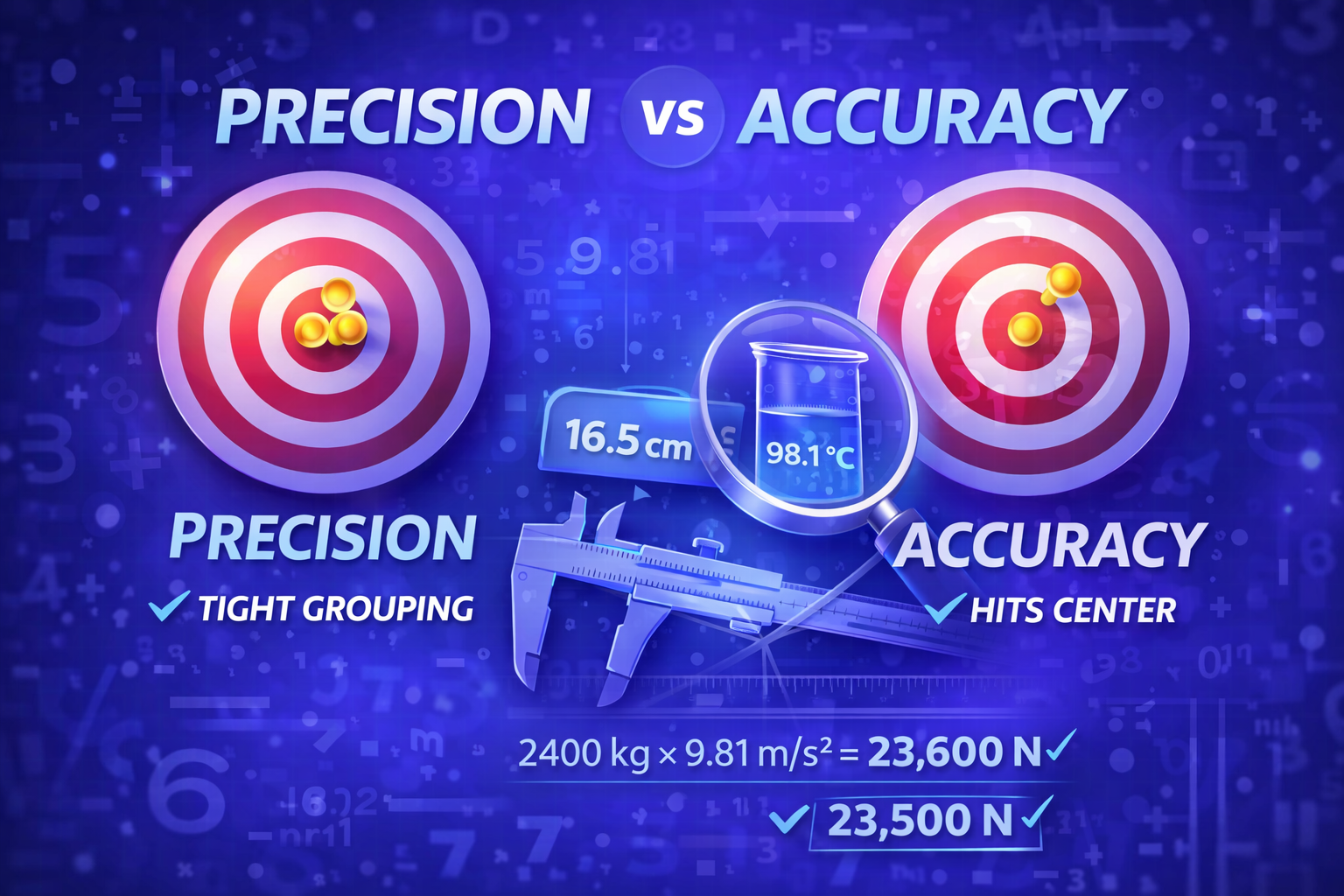
Precision refers to the level of detail and reproducibility in a measurement. If your instrument measures to the nearest hundredth, then digits in that place carry weight. Trailing zeros often indicate that level of precision, but only under specific rules.
In laboratories across the United States, precision errors can lead to costly miscalculations in pharmaceuticals, aerospace engineering, and manufacturing. According to the National Institute of Standards and Technology, measurement accuracy directly affects quality control and safety compliance in high-performance systems. When you understand how trailing zeros function, you protect your data integrity and strengthen your analytical credibility.
The Core Rules for Trailing Zeros
You follow clear rules to determine whether trailing zeros count as sig figs. These rules help you interpret numbers correctly and avoid ambiguity in scientific communication. When you apply them consistently, you maintain accuracy across calculations.
Here are the essential guidelines:
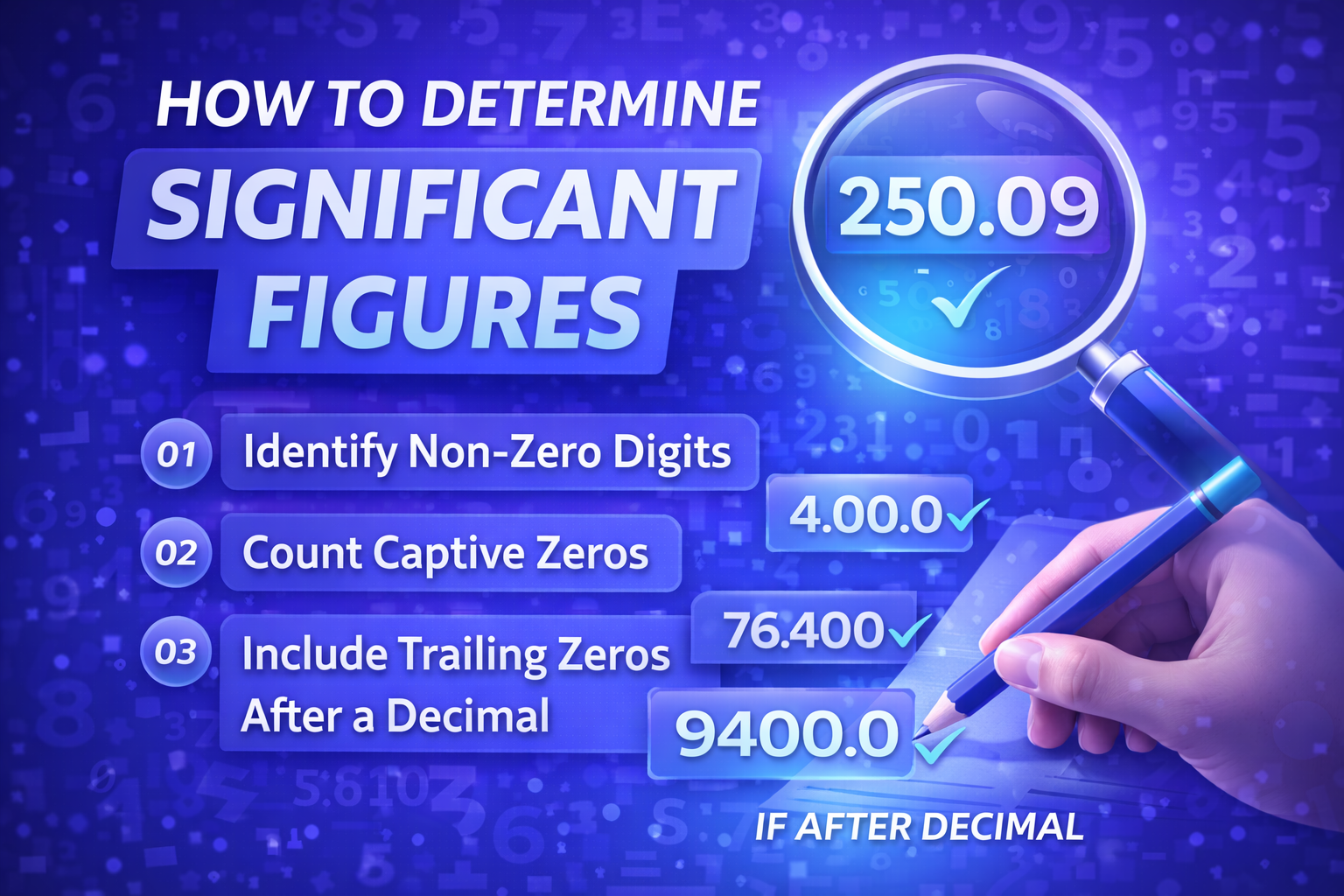
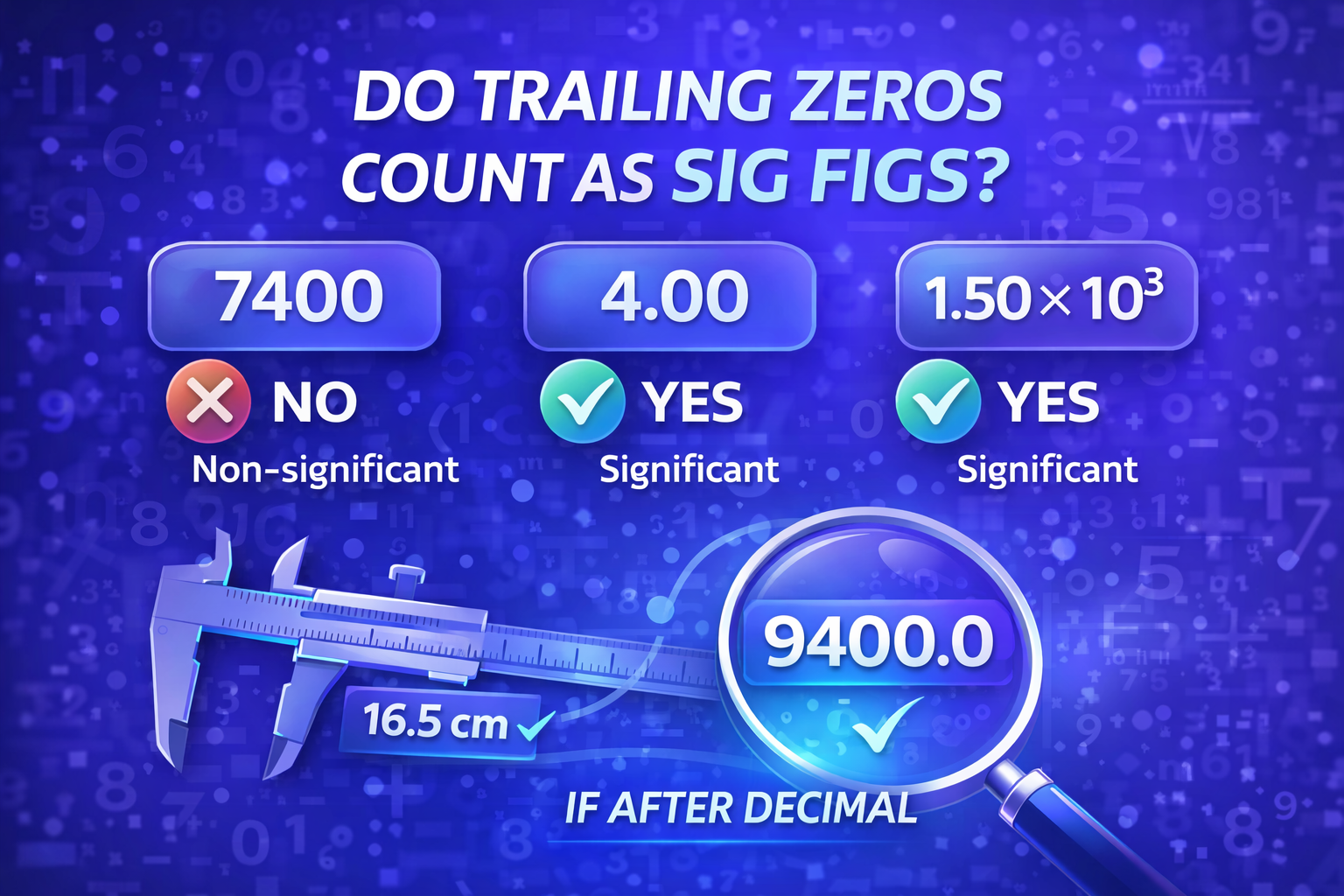
- Trailing zeros to the right of a decimal point are significant.
- Trailing zeros in whole numbers without a decimal point are typically not significant.
- Scientific notation removes ambiguity about significance.
If you see 92.00, the two zeros after the decimal are significant because they indicate measurement to the hundredth place. If you see 540, the trailing zero does not automatically count unless a decimal point or scientific notation clarifies intent. Context always matters when you interpret whole numbers.
Trailing Zeros After a Decimal Point
When a number includes a decimal point, trailing zeros usually count as significant figures. For example, 45.600 contains five significant figures because each zero shows that the measurement extends to the thousandth place. You communicate that your instrument is measured with high precision.
If you write 2.500 liters, you indicate that the measurement is accurate to the nearest thousandth of a liter. That final zero is not decoration; it reflects certainty about scale. Removing it would reduce the implied precision.
In clinical research, reporting dosage incorrectly by a decimal place can produce serious consequences. A number such as 1.20 mg communicates greater precision than 1.2 mg, even though the numeric value appears similar. Those trailing zeros tell readers exactly how refined your measurement process was.
Trailing Zeros in Whole Numbers Without Decimals
Whole numbers create the most confusion when discussing trailing zeros. If you write 1500 without a decimal point, readers cannot tell whether you measured to the nearest hundred, ten, or one. In standard convention, those trailing zeros are not automatically significant.
For example, 1500 may represent two, three, or four significant figures depending on context. Without clarification, it is usually interpreted as having only two significant figures, meaning the zeros act as placeholders. This ambiguity can distort scientific reporting.
To eliminate confusion, you should rely on notation techniques that clearly express intent. Writing 1500. or converting to scientific notation signals that the zeros are meaningful. When you remove ambiguity, you strengthen analytical transparency and support data-driven conclusions.
Scientific Notation Removes Ambiguity
Scientific notation gives you full control over significant figures. When you write 1.500 × 10³, you clearly indicate four significant figures, including the trailing zeros. The exponent does not affect the number of significant figures.
If you instead write 1.5 × 10³, you show only two significant figures. The difference between these two expressions directly affects rounding, multiplication, and division outcomes. You prevent misinterpretation by expressing numbers precisely.
When you calculate experimental values, you often convert ambiguous whole numbers into scientific notation before continuing. This step ensures that your subsequent operations reflect correct precision. In complex engineering models, even one miscounted significant figure can propagate rounding errors through large-scale computations.
Leading Zeros Versus Trailing Zeros
You must distinguish between leading zeros and trailing zeros. Leading zeros appear before the first nonzero digit and never count as significant figures. They only position the decimal point correctly.
For instance, 0.00450 has three significant figures because only the 4, 5, and final zero count. The zeros before the 4 are placeholders and do not convey precision. In contrast, the trailing zero after 5 shows that the measurement extends to the ten-thousandth place.
This distinction becomes critical when you round numbers or report lab results. If you misidentify placeholder zeros as significant, you inflate your precision artificially. Accurate interpretation keeps your measurements honest and defensible.
Why Trailing Zeros Matter in Real Calculations
Trailing zeros affect addition, subtraction, multiplication, and division differently. In multiplication and division, you round your final answer to the same number of significant figures as the least precise measurement. If you miscount trailing zeros, you risk overreporting accuracy.
In addition and subtraction, you round based on decimal places rather than significant figures. A number like 12.00 carries more decimal precision than 12.0, which changes how you present your final result. Small reporting differences can alter regulatory compliance documents.
To understand broader implications, you can review why precision affects applied fields by reading about why significant figures matter in science and engineering because clear reporting supports safety, research funding, and product reliability. When you respect trailing zeros, you demonstrate analytical discipline in every calculation you perform.
Ambiguous Numbers and Reporting Conventions
Sometimes you encounter ambiguous numbers like 1300 or 20000. Without additional notation, you cannot determine how many significant figures the author intended. This uncertainty undermines data clarity.
You can resolve ambiguity by:
- Adding a decimal point, such as 1300.
- Using scientific notation, such as 1.300 × 10³.
- Clearly stating measurement precision in context.
If you want a deeper breakdown of counting rules, you can reference what are the rules for significant figures to reinforce consistent interpretation in academic and professional settings. Clear formatting supports better communication across laboratories, classrooms, and engineering teams.
Exact Numbers and Infinite Precision
Not all numbers follow the same significant figure limitations. Exact numbers, such as counted objects or defined constants, have infinite significant figures. They do not restrict the precision of calculated results.
For example, if you count 12 test tubes, the number 12 is exact. If you convert units using a defined relationship, that conversion factor does not limit your answer’s significant figures. Only measured values impose rounding constraints.
Understanding this distinction prevents unnecessary rounding. When you combine exact and measured values, you base your final precision only on the measured quantities. This approach maintains logical consistency and mathematical integrity.
Avoiding Common Mistakes with Trailing Zeros
You can prevent errors by applying a structured approach. Always identify whether a zero is leading, captured between digits, or trailing after a decimal. Then determine whether the number is measured or exact.
Common mistakes include:
- Assuming all trailing zeros are significant.
- Ignoring decimal points when interpreting whole numbers.
- Failing to convert ambiguous numbers into scientific notation.
If you want to verify calculations quickly and eliminate manual errors, you can use a reliable Sig Fig Calculator to check rounding and significant figure counts before submitting academic or professional work. Digital verification tools reduce risk in high-stakes reporting environments.
Practical Examples to Strengthen Your Understanding
Consider the number 3.0800. It has five significant figures because the zero between 3 and 8 counts, and the two trailing zeros after the decimal also count. Each digit communicates measured precision.
Now compare 300 and 300.0. The first typically has one significant figure, while the second has four because the decimal point signals that each zero reflects measurement accuracy. That difference changes how you round future results.
Finally, compare 0.00250 and 0.0025. The first has three significant figures, while the second has two. Those final zeros may appear small, but they carry important meaning about instrument sensitivity and reporting standards.
Conclusion:
When you ask whether trailing zeros count as sig figs, the answer depends entirely on context and notation. Zeros after a decimal point are significant because they communicate measurement precision, while trailing zeros in whole numbers remain ambiguous unless clarified. Scientific notation provides the most reliable method for eliminating confusion and ensuring accurate reporting.
You strengthen your analytical skills when you apply these rules consistently. Clear interpretation of trailing zeros protects data quality, supports professional credibility, and reduces the risk of rounding errors in scientific and engineering calculations. By mastering significant figure conventions, you make informed decisions that reflect precision, transparency, and technical excellence.