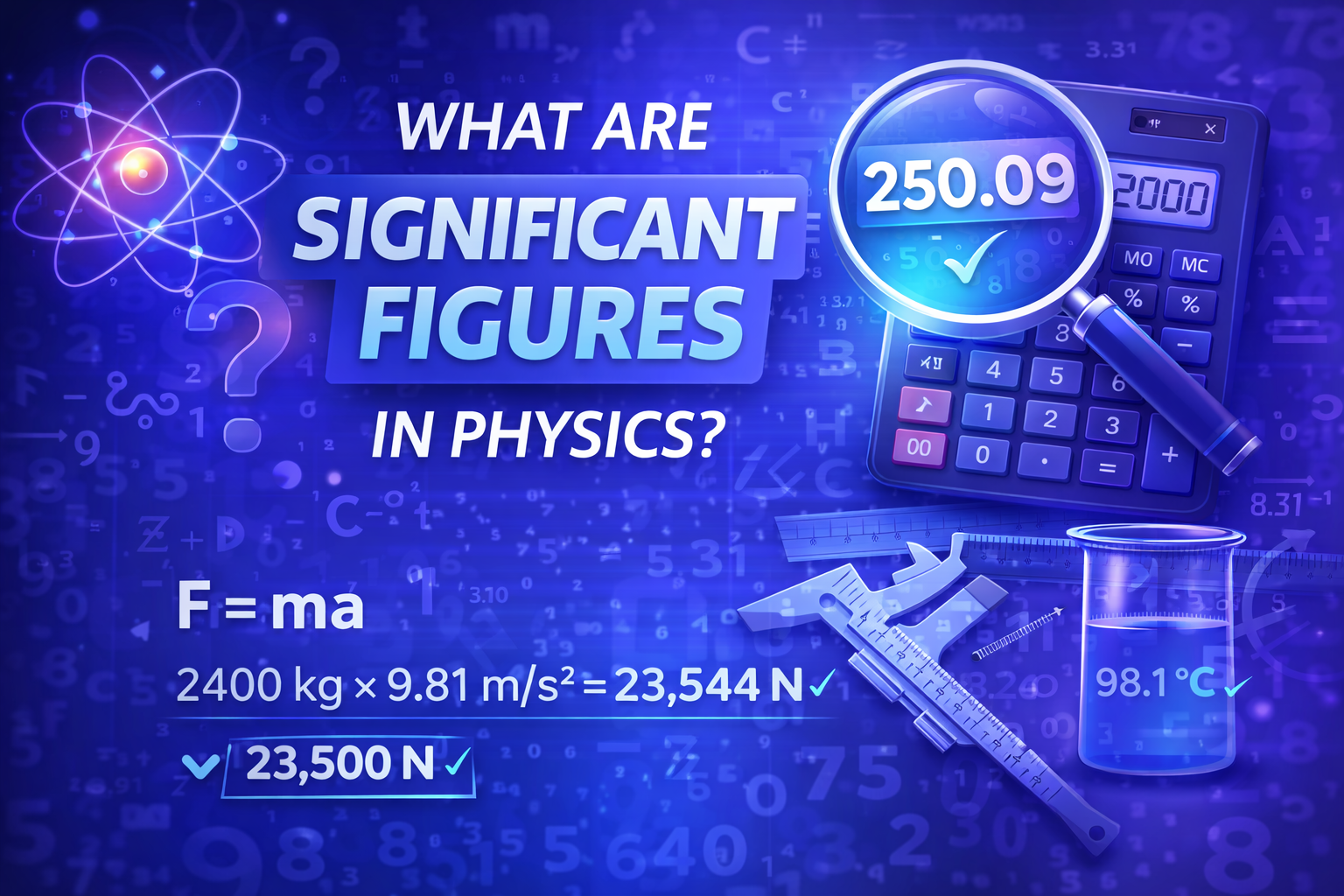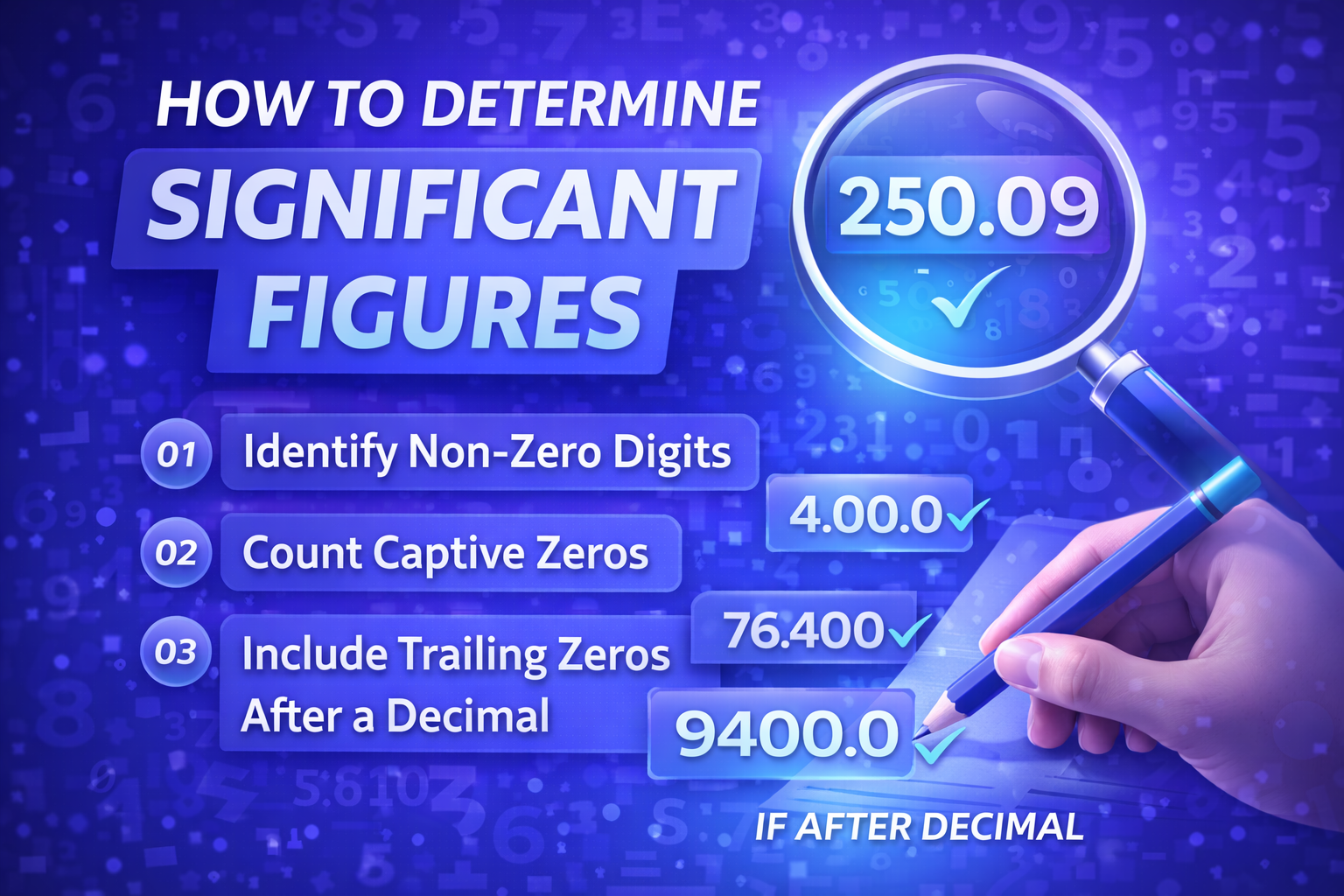
Significant figures are an easy way of demonstrating how accurate a number is. They indicate which digits are meaningful and which are not. Rounding numbers refers to the process of adjusting a value to match a required level of accuracy, rather than altering its true size.
Science, mathematics, engineering, and data reporting need this fundamental aspect. Any tiny rounding error can alter the quality of an outcome. The measurements, calculations, and final answers must be able to preserve the original data to an absolute accuracy.
Significant figures give a clear outline for doing it right. This system ensures the integrity through uniform and credible results. When rounding is done correctly, the result still represents the original number in the most accurate manner possible. To achieve that, you require a definite and conventional approach.
In this article, I will give you a step-by-step procedure through which you will learn the process of rounding numbers using significant figures.
How to Round Numbers Using Significant Figures
Rounding off significant figures implies that only the digits that show actual accuracy in a number should be retained. The approach uses meaningful figures instead of decimal points. That’s because counting always starts with the first figure that is not zero, since this is where the measured value actually begins.
Basic Rules You Must Know:
- The counting of significant figures begins at the first non-zero value.
- The last decimal place value is the figure that determines whether to round off or keep the number unchanged.
- Digits removed in the rounding do not have any impact on the value as long as the rules are applied.
- Zeros may be important or not depending on their locations.
Special Cases to Remember:
- Leading zeros do not count.
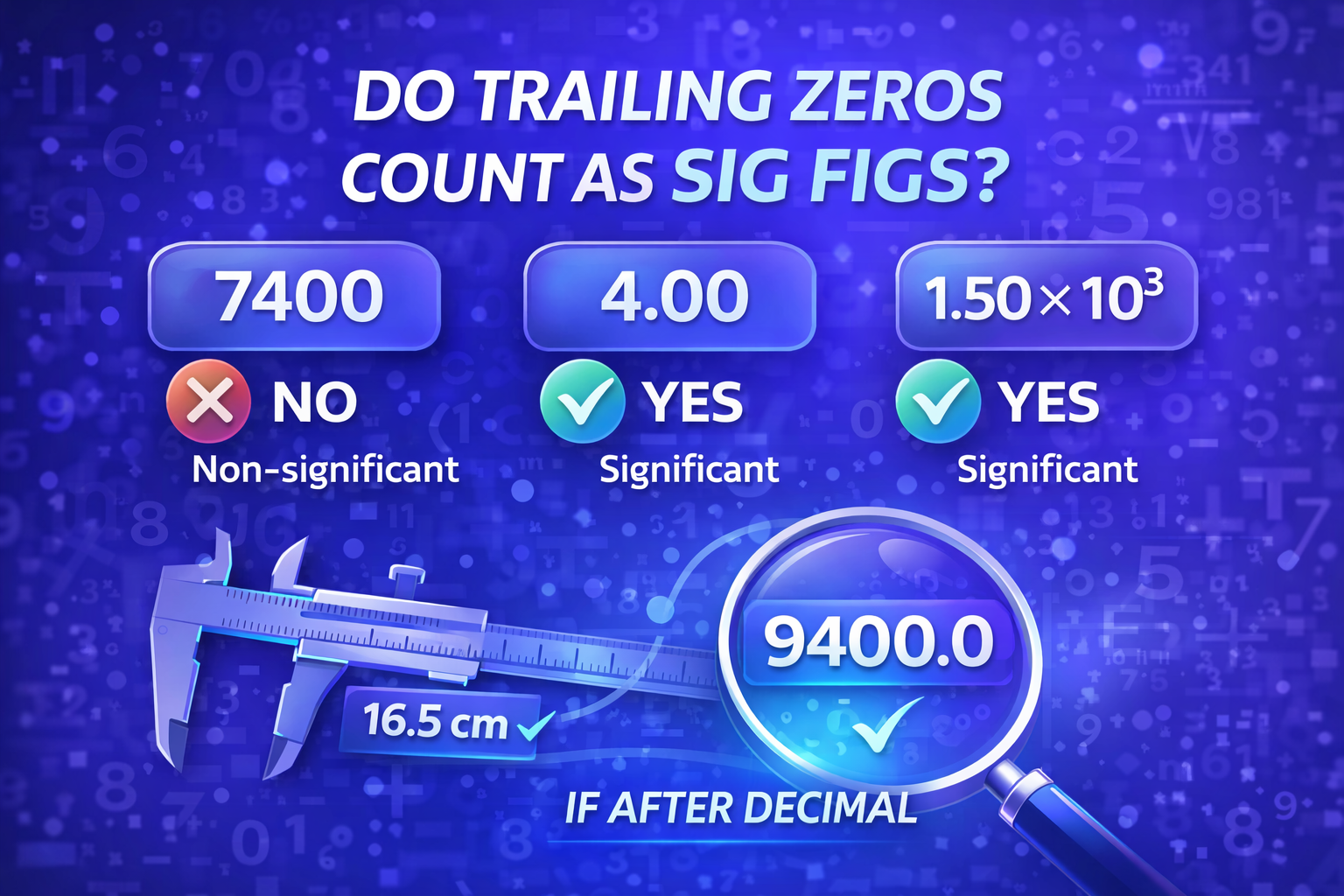
- Trailing zeros that come after the decimal point count.
- Whole numbers might require the use of scientific notation to express significant figures.
Step-by-Step Guide
Rounding numbers using significant figures follows a logical process. Each step follows logically to ensure the final value maintains the required accuracy. Once you understand the sequence, rounding the numbers will become consistent and uncomplicated.
- Determine the number of significant figures that are needed
Start by verifying the number of significant figures you must round to. This information is normally mentioned in the question or deduced from the context of the data. The required number of significant figures determines the level of accuracy that should be defined in the final result. Without this step, rounding cannot be done correctly.
Example:
Round off 0.012345 to 3 significant figures.
- Find the first non-zero digit and count significant figures.
The first non-zero digit should be counted since the leading zeros merely indicate the location of the decimal point and do not affect precision. The first significant value in 0.012345 is the value 1. The number of significant figures counted is 1, 2, and 3, making 3 the last digit to keep.
- Examine the digit that follows the last significant figure
Use the digit immediately after the final significant figure to determine whether rounding is required. When this digit is 5 or more, the last stored digit is added by one. When it is less than 5, the figure is retained. In our case, the decimal place value after 3 is 4, hence no rounding will be done.
- Write the rounded value
Keep only the required significant figures and delete all the other figures. The rounded off number would then be 0.0123, which retains three significant figures and maintains the same level of precision as the original value.
- Verify the result for accuracy
To verify the result, use Sig fig calculator to quickly check whether the rounding is correct or not. Simply put the original value and the number of significant figures you want to round to. As in our case, we need to round off to 3 significant figures, so do it like this:
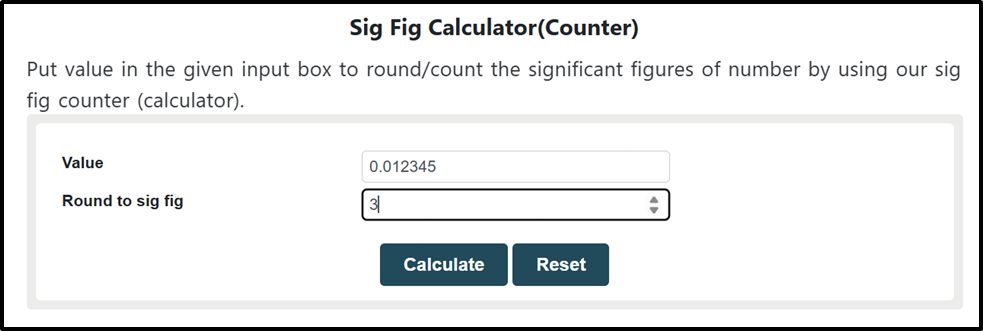
Once you click the “Calculate” button, the result will show up:

This confirms that 0.0123 is the correct rounding of 0.012345 to three significant figures.
Mistakes to Avoid When Rounding with Significant Figures
During the process of rounding off numbers using significant figures, there are certain errors that are highly prevalent. To get the correct and consistent results, the following errors must be avoided:
- Confusing significant figures with decimal places
Many learners round off by the number of decimal places rather than counting significant digits. Significant figures are based on meaningful digits and not on the location of the decimal point, and therefore, this error can give wrong results.
- Beginning with the count of zero rather than the first non-zero
Leading zeros are simply a placement of the decimal point and do not represent precision. Taking them into account as significant figures increases the chances of inaccurate results.
- Premature rounding in multi-step operations
Cumulative errors can be brought about by rounding off values in the middle of a calculation. Always make sure to only round off the final result.
- Misinterpretation of trailing zeros in whole numbers
A number like 1500 is ambiguous unless context is given. The assumption of the number of significant figures without clarification can misrepresent precision. This ambiguity should be eliminated by the use of scientific notation.
- Leaving out trailing zeros where they are necessary
In some cases, to present the right number of significant figures, zeros need to be added, e.g., 4.20 rather than 4.2. The exclusion of these zeros conceals the desired amount of precision.
Conclusion
Rounding numbers using significant figures is not only about reducing the length of numbers but also about maintaining accuracy.
Keep in mind to only round off at the final step and watch how zeros affect accuracy. Always use scientific notation when the accuracy of a number is not clear. These little practices eliminate mistakes and enhance the uniformity of the results.
Through frequent practice, it becomes easy and simple to round off significant figures in real-life calculations.
Related Post