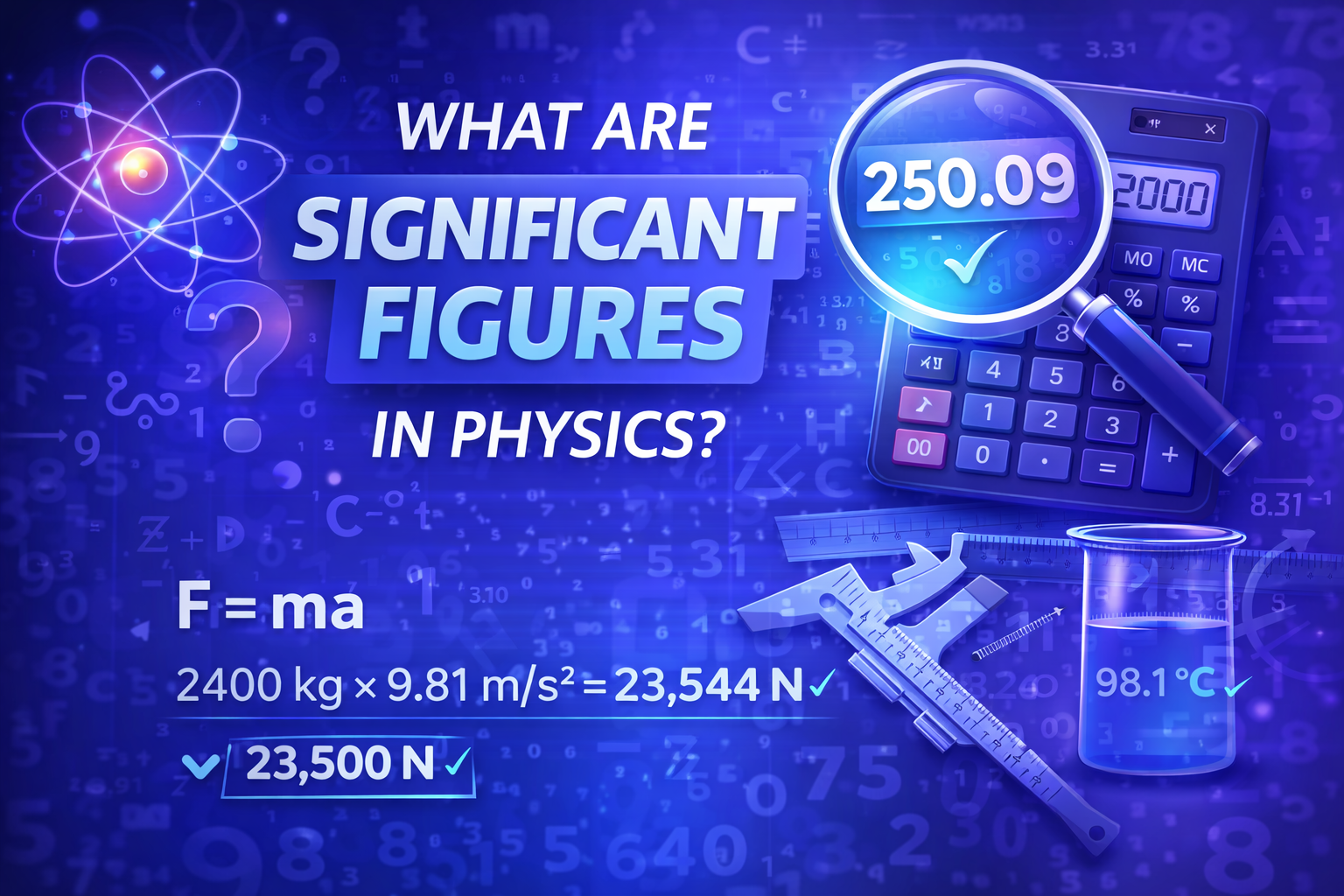
Significant figures are one of the most important concepts in scientific measurement that is primarily applied in mathematics, physics, chemistry, and other experimental sciences. However, with this importance, it is also one of the confusing concepts for students due to counting digits, handling zeros, and applying the rules correctly. Due to this confusion, even simple problems can feel difficult. This step-by-step student guide wipes out these problems with the following explanations.
- What are significant figures?
- Rules of Significant Figures
- How learners can practice and master significant figures manually and using modern online calculators and AI-based math solvers.
What are Significant Figures?
Significant figures are used to show how many digits in a number are important and meaningful. These important digits are called significant digits. They tell us how accurate a number is. They help avoid false precision and make sure results are reported correctly.
In simple words, Significant figures are the digits that really matter in a number. To find them, we start counting from the first non-zero digit on the left and count all meaningful digits according to the rules of significant figures.
Example:
- 12 cm has 2 significant figures
- 12.30 cm has 4 significant figures
The second number is more precise because the additional digits indicate a higher measurement precision.
Rules of Significant Figures
The rules discussed below will help write measurements and calculations with the correct level of accuracy. Once you understand the logic behind the rules, counting significant figures becomes much easier. Let’s discuss each rule with an example:
| Rules NO. | Description of Rule | Example |
| 1 | Every digit from 1 to 9 is always counted as a significant figure. | 456 → 3 significant figures
7.82 → 3 significant figures
|
| 2 | Any zero that comes between non-zero digits is counted. | 1005 → 4 significant figures
2.03 → 3 significant figures
|
| 3 | Zeros at the beginning of a number do not count as significant figures, but trailing zeros after a decimal point do. | 0.0047 → 2 significant figures
0.060 → 2 significant figures
|
| 4 | Zeros at the end of a number are significant if there is a decimal point | 5.20 → 3 significant figures
3.000 → 4 significant figures
|
| 5 | If a number has no decimal point, trailing zeros may not be significant unless specified. | 1500 → ambiguous significant figures
1500. → 4 significant figures
|
| 6 | In scientific notation, only the digits before the power of 10 are significant. | 4.50 × 10³ → 3 significant figures |
After learning the rules, some students may get confused or stuck because zeros can behave differently depending on their position. Leading zeros don’t count, trailing zeros may or may not count, and middle zeros are always significant. Students may also make mistakes when rounding numbers or using scientific notation.
How to Identify and Count Significant Figures
To solve and find the significant figures (sigfigs) without any confusion, follow the steps below.
- Start counting from the first non-zero digit on the left.
- Count all non-zero digits as significant figures.
- Ignore leading zeros because they are not significant.
- Count zeros that are between non-zero digits.
- Check for trailing zeros and determine if a decimal point is present to decide if they are significant.
- Convert the number into scientific notation to simplify counting.
- Apply the correct number of significant figures and round the final answer properly.
After following these steps and practicing them regularly, significant figures often become easier to understand for the students. However, confusion can still happen because of tricky zero rules and rounding. To avoid this situation and solve problems correctly, students can use the Sig Fig Calculator as a helpful assistant.
Sometimes, students are not just confused about the final answer but also about the solution. They may not understand how the final answer is reached. This is where AI math solver becomes helpful. It solves each question step by step and explains clearly, which removes confusion.
It works like a study guide and can create practice problems to improve learning and confidence.
Solved Examples of Significant Figures
Let’s solve a few different examples to grasp the concept of significant figures.
Example 1:
Find the number of significant figures in 0.00450
- Ignore the leading zeros (0.00)
- Start counting from the first non-zero digit (4)
- The trailing zero after the decimal is significant
Answer: 3 significant figures
Example 2:
Find the number of significant figures in 12.300
- Start from the first non-zero digit (1)
- Count all non-zero digits
- Trailing zeros are significant because there is a decimal point
Answer: 5 significant figures
Example 3:
Find the number of significant figures in 1050
- Start from the first non-zero digit (1)
- Zero between non-zero digits is significant
- The trailing zero without a decimal point is usually not considered significant unless specified by context.
Answer: 3 significant figures
Example 4:
Find the number of significant figures in 6.02 × 10³
- In scientific notation, only count digits before ×10
- Digits 6, 0, and 2 are significant
Answer: 3 significant figures
| Suggestion: To verify all the above answers, you can use the Sig Fig Calculator.
|
Final Words
Significant figures are an important part of science and applied math. Understanding these makes your measurements and calculations more accurate. The concepts may feel difficult at first due to the different rules and behaviors of zeros.
But following the steps that were discussed above can make it easier to understand them correctly. By practicing regularly and going through different examples, students can gain confidence and avoid common mistakes.