Have you ever wondered how computers represent numbers behind the scenes? If yes, hexadecimal plays an important role in that process. It is a base-16 numbering system that is widely used in computing, programming, digital color codes, and many other technical applications.
Decimals are natural and easy for humans to understand, but computers work internally with binary data. Hexadecimal is often used as a readable representation of that binary information, which makes handling and interpreting values more efficient. So, a question arises: how exactly can you transform a decimal number into a hexadecimal system?
To understand this clearly, read this blog post till the very end. Without delaying further, let’s dig into the details.
Two Methods to Convert Decimal Numbers into Hexadecimal Systems
Below, we have discussed two different methods that you can adopt to convert decimal numbers into hexadecimal.
Manual Method
In the manual method, you are required to carefully follow the steps mentioned below.
1. Divide the Decimal Number by 16
First of all, you should divide the required decimal number by 16. Wondering why 16 specifically? This is because hexadecimal is a 16-base format.
Let’s use a decimal number “156” as an example here. After dividing it by 16, the quotient will be 9 with a remainder of 12.
The quotient will be divided again, and the remainder will be one of the hex digits
2. Convert the Remainder into Hexadecimal
Now, it is time to transform the remainder into a hexadecimal equivalent. The remainder from the previous step was 12…right? So we will be proceeding with it.
Check out the hexadecimal conversion table to learn about the value of 12 and other numbers.
Apparently, 12 = C
So, our first hexadecimal digit is C.
3. Divide the Quotient Again by 16
Divide the quotient (9) from the first step again by the digit 16.
9 ÷ 16 = 0 (quotient) with a remainder of 9.
Since the output is 0 now, the division process stops here.
4. Convert the Final Remainder
Finally, you have to convert the final remainder 9 into hexadecimal by checking its value from the table.
And the value of the remainder 9 from the table is actually 9, because it is less than 10.
5. Read the Remainders in Reverse Order
Now, read both the remainders in reverse order. In our case, it will be 9C.
Final Result:
The final output is 15610 = 9C16
Automated Method
If you want to save both time and effort, then the automated conversion method is best for you. On the internet, there is a huge variety of tools available. These tools can convert the given value into hexadecimal numbers with a single click.
To show you how it works, we’ll use a decimal to hex converter (https://www.prepostseo.com/tool/decimal-to-hex) in the following demonstration.
Here’s what you need to do:
- Enter the decimal number in the dedicated input field.
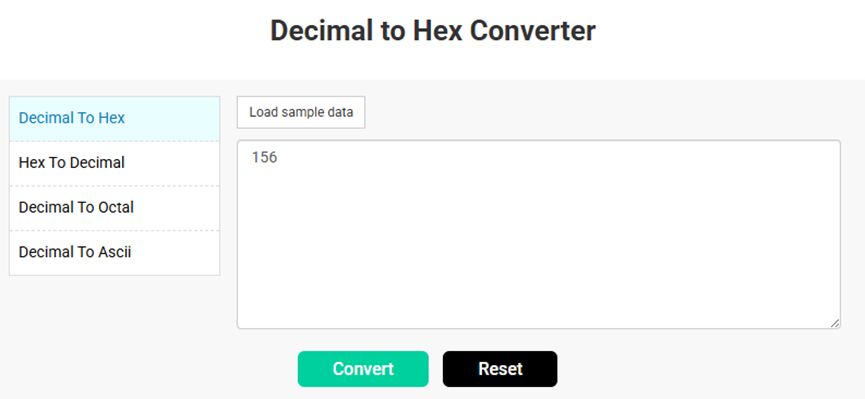
Hit the button, and wait for the results. In our case, here’s how the decimal number was instantly converted into its hexadecimal equivalent.
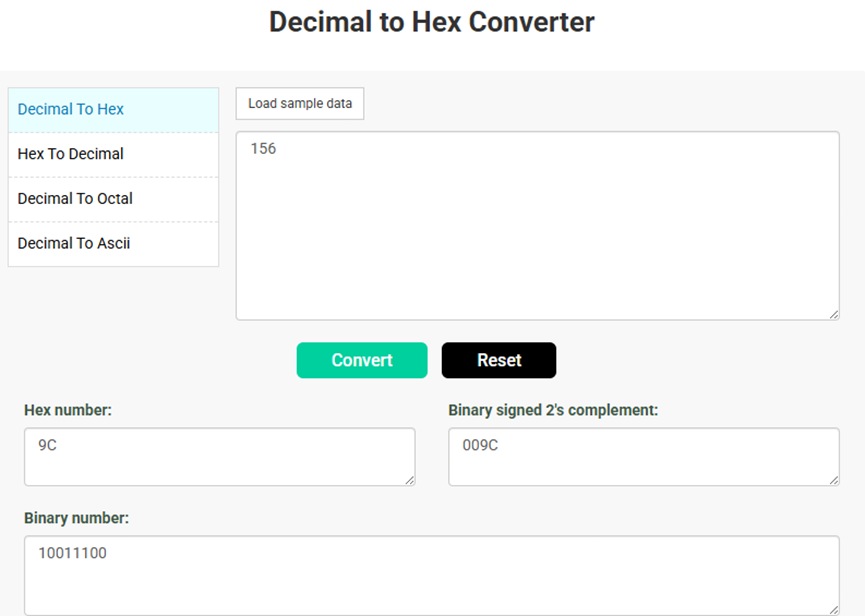
That’s how you can quickly convert decimal numbers into its hexadecimal equivalents with the help of a specialized online tool.
Final Thoughts
There is no doubt that converting decimal numbers into hexadecimal systems may seem a complex task at first glance. However, when you understand the concept and the step-by-step procedure, the conversion becomes both logical and easy to apply. In this blog post, we have discussed two methods that can be adopted in this regard.
One method is manual, which is not only time-consuming but also has a chance of making errors. The second one is automated by utilizing online tools.
Frequently Asked Questions
What exactly is a hexadecimal number system?
It is a base-16 numbering system that uses the digits 0-9 and letters A-F. This numbering system is widely used in computing and programming, as it offers a compact and readable representation of binary data.
Why is hexadecimal system used in computers instead of decimal?
This is because the hexadecimal system closely aligns with the binary system that is used by computers. One hexadecimal digit represents four binary bits, making it easier to read.
What is the simple method of transforming decimal numbers into hexadecimal?
The easiest and quickest way to perform the conversion of decimal numbers into the hexadecimal system is by utilizing a decimal to hex converter.
Related Post