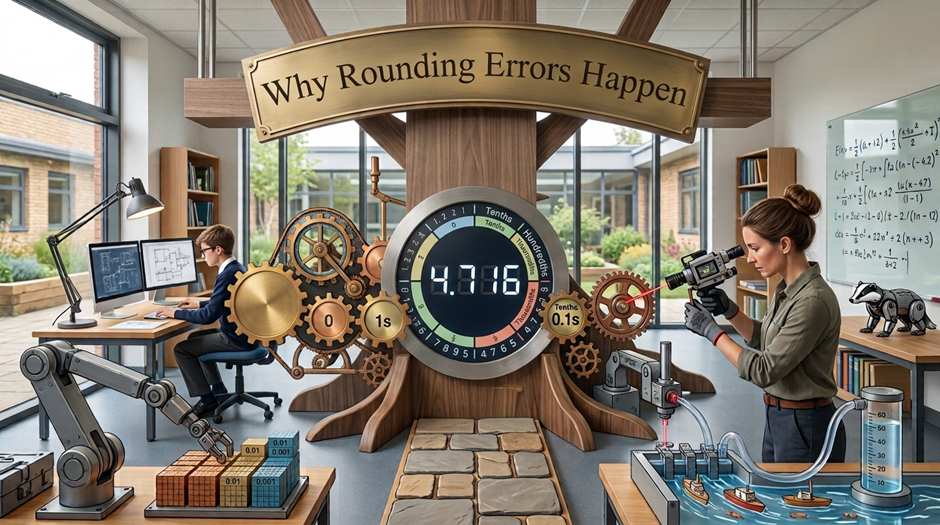
Rounding errors occur when a number is rounded incorrectly or when rounding is performed at the wrong stage of a calculation. For example, when rounding 4.67 to the nearest tenth, look at the hundredths digit, 7. Because it is 5 or greater, increase the tenths digit from 6 to 7, giving 4.7. Errors often occur when students are unsure of which digit to use.
Rounding in math also requires students to know when they should round. Students who need help with rounding, place value, or multi-step calculations can work with Brighterly math tutors to practice these skills.
What Is Rounding in Math?
Rounding in math means changing a number to a simpler value that is close to the original. The answer keeps the level of accuracy required by the problem.
For example:
- 73 rounded to the nearest tenth is 6.7
- 78 rounded to the nearest tenth is 6.8
- 846 rounded to two decimal places is 3.85
Look at the digit right after the place you need to round. If it is 5, 6, 7, 8, or 9, add 1 to the digit you are rounding. If it is 0, 1, 2, 3, or 4, just leave the digit being rounded unchanged. Nearest tenth, two decimal places, and three significant figures each tell you to round the number in a different way.
The Missing Foundation: Place Value and Significant Figures
Many rounding mistakes start with place value. A student may know the rounding rule but look at the wrong digit.
How weak place-value understanding leads to rounding the wrong digit
Take the number 8,462.37.
Each digit has a different place:
- 8 is in the thousands place
- 4 is in the hundreds place
- 6 is in the tens place
- 2 is in the ones place
- 3 is in the tenths place
- 7 is in the hundredths place
If the question asks you to round 8,462.37 to the nearest tenth, start with the 3. Then look at the 7 next to it. Students may analyze a number incorrectly or forget to which number it is rounded. Therefore, they first need to identify the place value they are rounding to and then examine the digit immediately to its right.
Significant figures as the “rulebook” for rounding in science and engineering
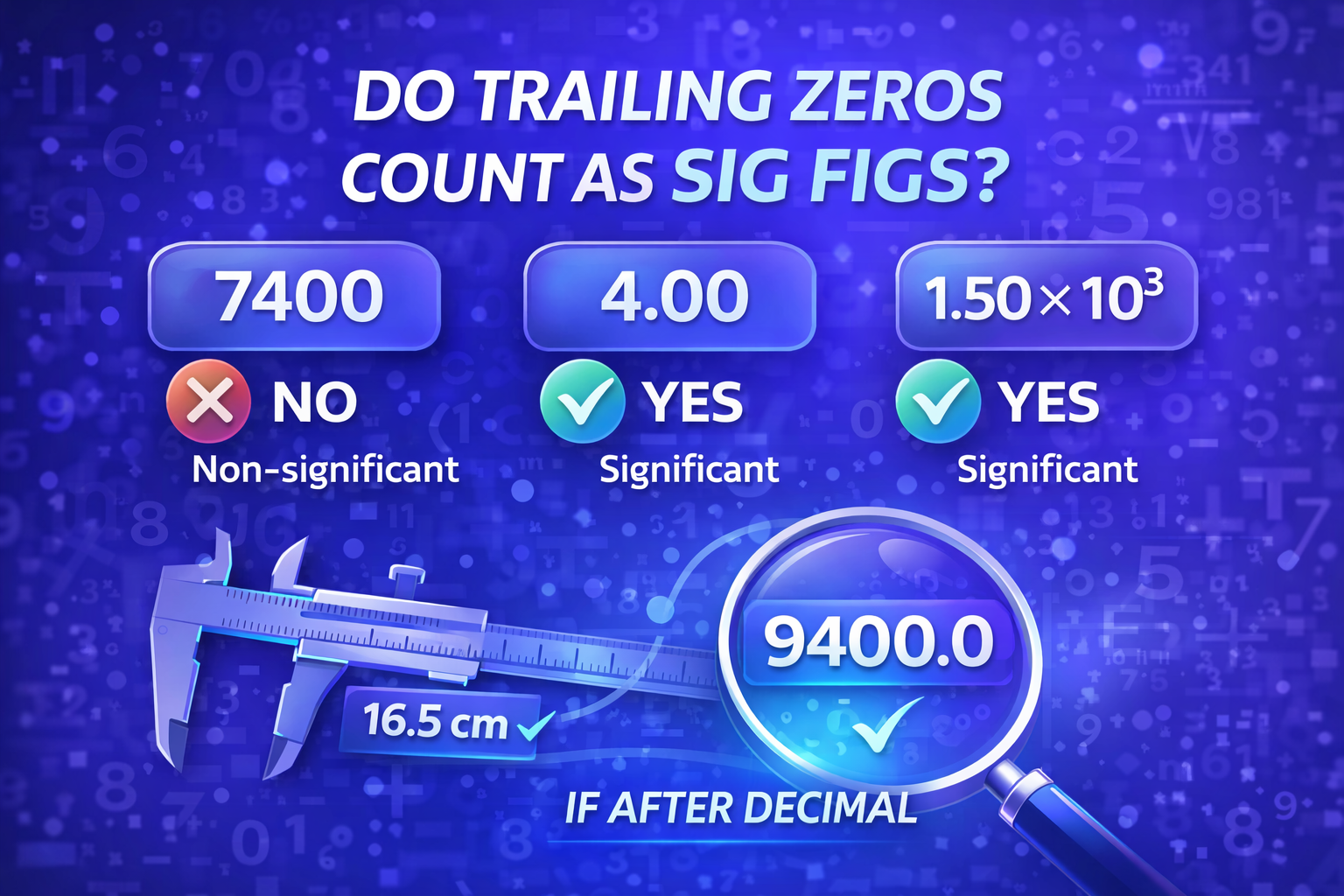
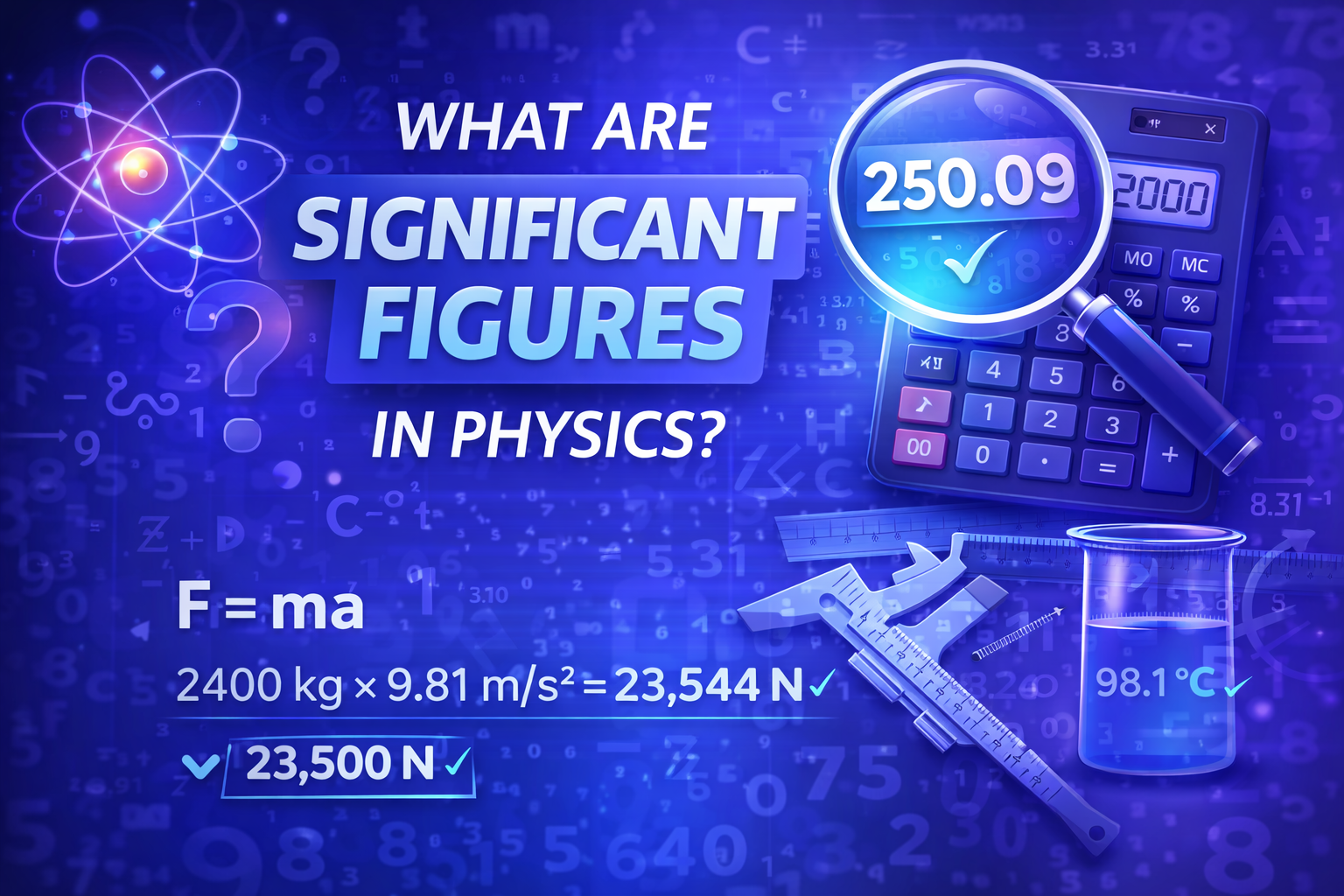
Scientists and engineers use significant figures when they report measurements and calculation results. For example, if a lab measurement is 12.46 cm and the result must have three significant figures, it should be reported as 12.5 cm.
The same rules are used to calculate the results. If an engineer calculates a length of 4.786 m and needs three significant figures, the result becomes 4.79 m. The final number should show only as much detail as the question or measurement requires. For more examples of how to apply these rules, see this step-by-step guide to rounding numbers using significant figures.
Where Rounding Errors Show Up in Real Work
Rounding errors can change the final result when a calculation has several steps. The problem starts when a student rounds a number and then uses that shorter number in the next calculation.
For example:
18.736 × 2.45 = 45.9032
If a student rounds 18.736 to 18.7 first, the calculation becomes:
18.7 × 2.45 = 45.815
The answers differ because the second calculation uses a rounded value.
Incorrect rounding can be a problem in financial calculations. If a student calculates a monthly payment of $248.67 and rounds it to $249 before continuing, the next calculation will use $249 instead of $248.67. If the student then multiplies the payment by 12, they will get $2,988 instead of $2,984.04. The difference comes from rounding the monthly payment before the calculation was finished.
It can also happen with measurements. If a student measures a length of 12.46 cm and rounds it to 12.5 cm before using it in the next calculation, the next step will use 12.5 cm instead of 12.46 cm. If the calculation involves several more steps, each step will use the rounded value, which can change the final answer.
For example, if the student needs to multiply 12.46 × 3, the result is 37.38 cm. If they use the rounded value 12.5 × 3, the result becomes 37.5 cm. The difference comes from rounding the measurement before finishing the calculation.
Rounding Errors in Digital Systems
Rounding is not only something we encounter in school, but also in everyday life. Understanding what rounding is in math is also important when working with calculators, spreadsheets, and software that work with tenths, hundredths, and thousandths.
A calculator or spreadsheet may display fewer digits than the stored value. For example, a spreadsheet might store 2.666666 but display 2.67. In Excel calculations, the number shown in a cell is not always the exact value used in subsequent calculations.
This is also important when copying a number (obtained from calculating the result) and transferring it to another calculation. It is possible to copy a rounding error without realizing it.
The same problem can occur with automated grading. The evaluation script needs clear rules regarding decimal places, significant figures, and the allowable difference between two numerical answers.
Floating-point and display-rounding quirks in calculators, spreadsheets, and grading scripts
Computers store numbers using a limited number of digits. Some decimal numbers cannot be represented exactly, so the stored value may differ slightly from the number shown to the user.
Display settings can create another problem. A spreadsheet might show 1.23, while the formula uses 1.234567.
If the user starts another calculation with the displayed value 1.23, the result may differ from that of a calculation using the stored value.
Automated grading systems face a similar problem. If one system expects 4.79 and another expects 4.790, both may represent the same value, but the system needs a clear rule to know whether both answers should be accepted.
This is why software needs well-defined rules for precision rather than simply comparing numbers as text.
Why “the computer said so” isn’t the same as mathematically correct
A calculator can perform the calculation, but it does not know what the question requires.
For example, a calculator gives 7.8462. If the question asks for three significant figures, the answer is 7.85. If it asks for the exact value, rounding the answer to 7.85 would be wrong. The student still has to read the instructions and decide how the answer should be reported.
The same idea applies to spreadsheets and grading scripts. A computer can follow a formula correctly and still produce a result that does not match the required format if the precision rule is not defined.
Building Rounding Skills the Right Way
To improve rounding skills, it is important to analyze where the problem is occurring. Start with numbers, then move on to decimals, hundredths, thousandths, and multi-step calculations.
A student who cannot identify the hundredths place needs practice with numbers. A student who knows what tenths, hundredths, and thousandths are but has problems with rounding needs practice with rounding. When practicing multi-step calculations, keep the full unrounded value until the final step. If the calculator gives 248.67, do not replace it with 249 before using it again unless the problem specifically says to round to that value.
After rounding, have your child check themselves by asking:
- Did I round to the number specified in the problem?
- Did I use the correct number of decimal places or significant figures?
- Did I round before the last step when the problem did not ask me to?
To check the final answer, parents can use a sig-fig calculator. If the device gives a different answer, it is worth going back to the calculations and finding where the error occurred.
Simple exercises to test place-value and sig-fig understanding
Give students one number and ask several questions about it.
Use 6,482.735 and ask:
- Round it to the nearest ten
- Round it to the nearest hundred
- Round it to two decimal places
- Round it to three significant figures
- Identify the digit used to decide each answer
For 6,482.735:
- Nearest ten → 6,480
- Nearest hundred → 6,500
- Two decimal places → 6,482.74
- Three significant figures → 48 × 10³.
This exercise shows whether the student can identify the correct place before applying the rounding rule.
Next, use a multi-step calculation:
15.72 × 3.48 = 54.7056
Ask the student to give the final answer to two decimal places. The student should use 54.71.
Then ask what happens if 15.72 is rounded to 15.7 before the multiplication. This lets the student see how an early rounding decision can change the final result.
How structured, one-on-one math support helps close these specific gaps early
Because the problem begins with a different math skill, some students need help with rounding. They might round a multi-step problem too soon or mix up place value, decimal places, and significant figures.
For example:
- A student choosing the wrong digit needs place-value practice
- A student confusing decimal places and significant figures needs side-by-side examples
- A student rounding after every step needs practice with full calculator values
- A student ignoring the rounding instruction needs practice reading the question before calculating
Math tutors for rounding can work on these specific mistakes instead of giving the student more general math exercises.
One-on-one support can also help parents see whether the problem is limited to rounding or connected to a wider difficulty with decimals and number sense. For students who need this type of focused practice, Brighterly math tutors can work with them on the specific math skills behind the errors.
Conclusion
Rounding may seem like a small step, but it can change the result of the entire calculation, and that result may be incorrect. It is important to study the conditions of the problem in detail to understand to which tenths, hundredths, or thousandths you should round. Just like in life, rounding is important in calculations, measurements, financial planning, and everyday situations involving numbers.
Related Post