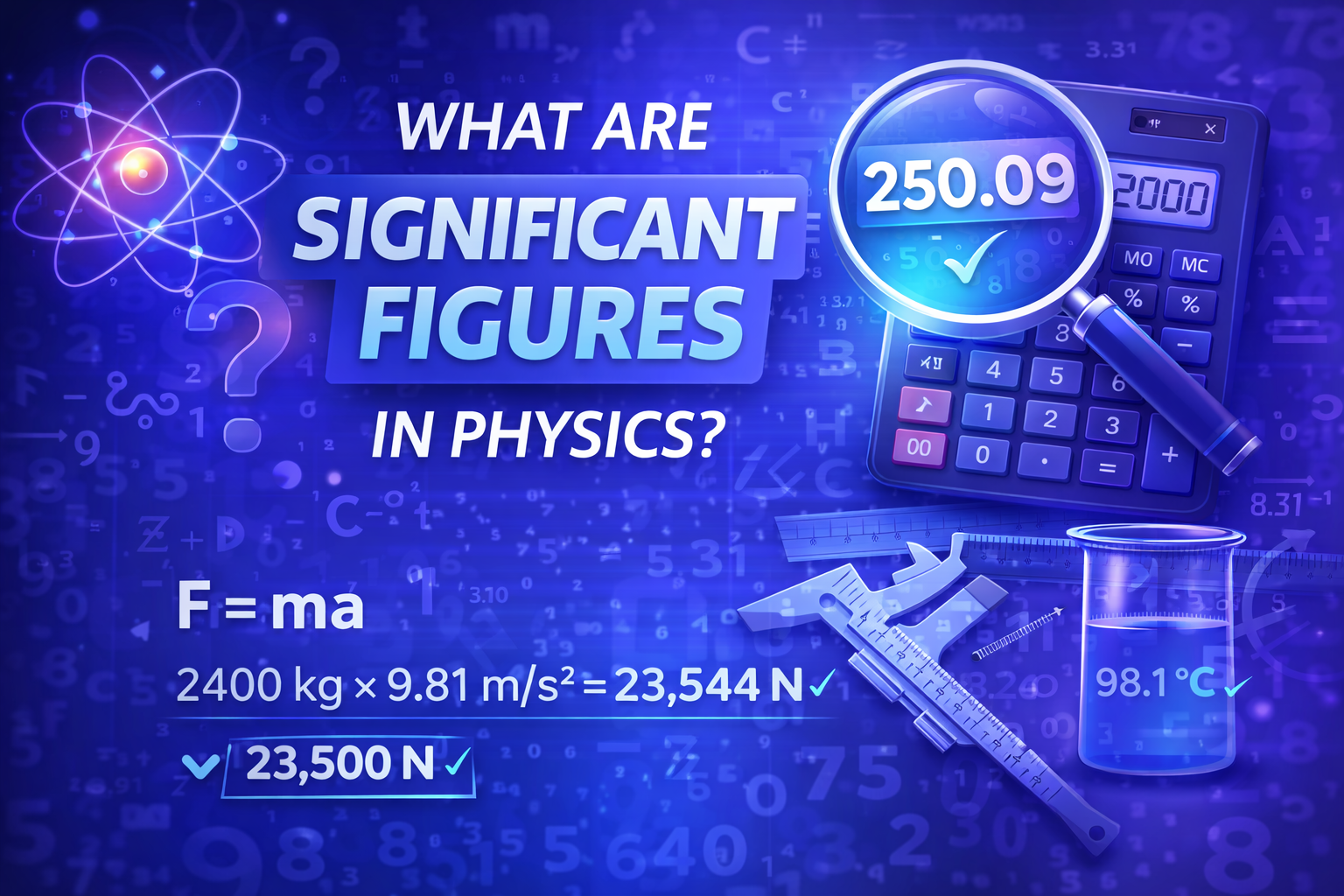
Understanding what is significant figures in physics allows you to report measurements honestly and accurately in scientific work. When you measure distance, time, mass, or velocity, you never obtain perfect precision, so significant figures communicate the certainty of your measurement.
In this guide, you will learn how they work, why they matter, and how to apply them correctly in real physics problems.
What Is Significant Figures in Physics?
When you ask what is significant figures in physics, you are really asking how scientists express measurement precision without overstating certainty. Significant figures are the digits in a number that carry meaningful information about accuracy, including all certain digits plus one estimated digit. This system prevents you from reporting results that appear more precise than your measuring instrument allows.
In physics, every measurement contains uncertainty, whether you use a ruler, digital scale, or stopwatch. The last digit you record reflects your best estimate within the smallest scale division of your instrument. By limiting your answer to appropriate significant figures, you communicate honesty and scientific integrity in your calculations.
Why Significant Figures Matter in Scientific Reporting
Precision drives scientific credibility, especially in physics experiments where small errors can alter conclusions. If you calculate velocity as 12.348976 m/s from measurements that were only accurate to three digits, you misrepresent your data. Significant figures ensure your final result matches the least precise measurement used.
Researchers, engineers, and laboratory technicians rely on consistent rounding standards to compare data reliably. According to national science education statistics, measurement error accounts for a substantial portion of laboratory discrepancies in high-school and undergraduate physics courses. When you understand rounding limits, you reduce misinterpretation and protect the validity of your findings.
Core Rules for Identifying Significant Figures
To master what is significant figures in physics, you must apply consistent counting rules. These rules determine which digits are meaningful and which are placeholders. Once you internalize them, you can evaluate any number quickly and accurately.
Non-Zero Digits
All non-zero digits are always significant because they represent measured values. For example, 45.7 contains three significant figures. Each digit reflects actual measurement precision.
Zeros Between Non-Zero Digits
Zeros located between non-zero digits are significant because they hold measured value positions. In 105.02, both zeros count as significant. The number contains five significant figures.
Leading and Trailing Zeros
Leading zeros before the first non-zero digit are not significant because they only position the decimal point. For instance, 0.0045 has two significant figures. However, trailing zeros after a decimal point, such as 2.300, are significant because they indicate measured precision.
If you want deeper clarity on rule application, you can strengthen your understanding by reading what are the rules for significant figures because consistent rule application prevents calculation errors in physics problems.
Significant Figures and Scientific Notation
Scientific notation removes ambiguity when dealing with very large or very small numbers. Writing 3,000 could imply one, two, three, or four significant figures, but expressing it as 3.0 × 10³ clearly shows two significant figures. This clarity protects you from misinterpretation in technical communication.
In physics, you frequently handle values such as 6.02 × 10²³ or 9.81 × 10⁰. Scientific notation ensures only digits before the exponent count as significant. By using this format, you make your results transparent and professionally acceptable.
Addition and Subtraction in Physics Calculations
When adding or subtracting measurements, you focus on decimal places rather than total significant digits. The result must match the least precise decimal place among the values being combined. This rule prevents false precision in summed quantities.
For example, if you add 12.11 and 0.3, your result becomes 12.4 rather than 12.41. The second number limits precision to one decimal place. By following this method, you align your answer with actual measurement capability.
Multiplication and Division Rules
Multiplication and division require you to match the smallest number of significant figures among the inputs. If one measurement has two significant figures and another has four, your final answer must contain only two significant figures. This rule maintains proportional accuracy.
Suppose you divide 10.0 meters by 3.0 seconds to find speed. Because both values contain three and two significant figures respectively, your result must contain two significant figures. Applying this method ensures your physics solutions remain trustworthy and standardized.
Rounding and the Round to Even Rule
Rounding plays a crucial role in what is significant figures in physics because it determines how you present final answers. When the first dropped digit is less than five, you round down, and when it is greater than five, you round up. However, when the digit is exactly five with no additional digits following, you apply the round to even rule.
The round to even method reduces long-term rounding bias in scientific datasets. For example, 2.35 rounded to two significant figures becomes 2.4 because the previous digit is odd, while 2.25 becomes 2.2 because the previous digit is even. This consistent approach supports accuracy across repeated measurements.
If you want to practice rounding confidently, reviewing step by step guide to rounding numbers using significant figures can sharpen your decision-making process in complex physics calculations.
Exact Numbers and Defined Constants
Not all numbers in physics limit your precision. Counted quantities such as 12 students or defined constants such as 2.54 centimeters per inch are exact and contain unlimited significant figures. These values do not restrict rounding in calculations.
Mathematical constants like π or conversion factors defined by international standards also behave as exact values. When you include them in equations, they do not reduce the number of significant figures in your final answer. Recognizing exact numbers prevents unnecessary rounding mistakes.
Measurement Uncertainty and Instrument Precision
Every measuring instrument has a smallest readable scale division. If your ruler measures to the nearest millimeter, you estimate one additional digit beyond that smallest marking. This final estimated digit forms the last significant figure.
More advanced digital instruments may display additional decimal places, but you should verify manufacturer precision guidelines. Reporting more digits than the device reliably measures introduces false accuracy. In physics, your credibility depends on respecting instrument limitations.
Common Mistakes Students Make
Many students confuse decimal place rules with significant figure rules. They often round too early in multi-step calculations, which compounds error and alters final results. Keeping extra digits during intermediate steps prevents cumulative distortion.
Another common mistake involves misunderstanding trailing zeros in whole numbers. Writing 1500 without context creates ambiguity, but expressing it as 1.5 × 10³ removes doubt about precision. Avoiding these pitfalls strengthens your physics performance and analytical confidence.
If you want to check your answers quickly while studying, you can apply a reliable Sig Fig Calculator to verify rounding and counting accuracy before submitting assignments. Using such a tool responsibly supports learning rather than replacing understanding.
How Significant Figures Support Real-World Physics
Significant figures extend beyond classrooms into engineering, aerospace, and medical research. NASA mission calculations, for example, rely on precise measurement protocols to avoid catastrophic errors. Even small rounding mistakes can alter trajectory computations in high-stakes environments.
In manufacturing and structural design, precision standards determine material tolerances and safety margins. Reporting correct significant figures prevents costly overdesign or dangerous underestimation. When you apply these principles consistently, you align with professional scientific standards used across the United States.
Conclusion
Understanding what is significant figures in physics empowers you to communicate measurements honestly and accurately. You now know how to identify meaningful digits, apply addition and multiplication rules, and round using unbiased methods that preserve data integrity. When you respect measurement limits, use scientific notation appropriately, and avoid premature rounding, you strengthen both academic performance and professional credibility.
Significant figures are not arbitrary classroom rules but essential tools for accurate scientific communication. By applying them carefully, you demonstrate respect for measurement uncertainty and ensure that every reported value reflects genuine precision. Mastering these principles prepares you for advanced physics study, laboratory work, and real-world technical problem-solving where accuracy truly matters.